Pressure keeps changing
A pressure problem can come from the fill valve, expansion tank, relief valve, air in the system, or a leak that only shows itself under heat.
Heating service in Herkimer County has to account for rural fuel access, older hydronic systems, long winters, and lake-effect cold.
Oil, Propane & Boiler Service in Herkimer County, NY should feel like a clear kitchen-table conversation, not a sales pitch. It should help you understand what is happening, what matters most, and what next step protects comfort, safety, and money.
Use these service links when the condition needs action. The rest of the page explains what the symptom may mean.
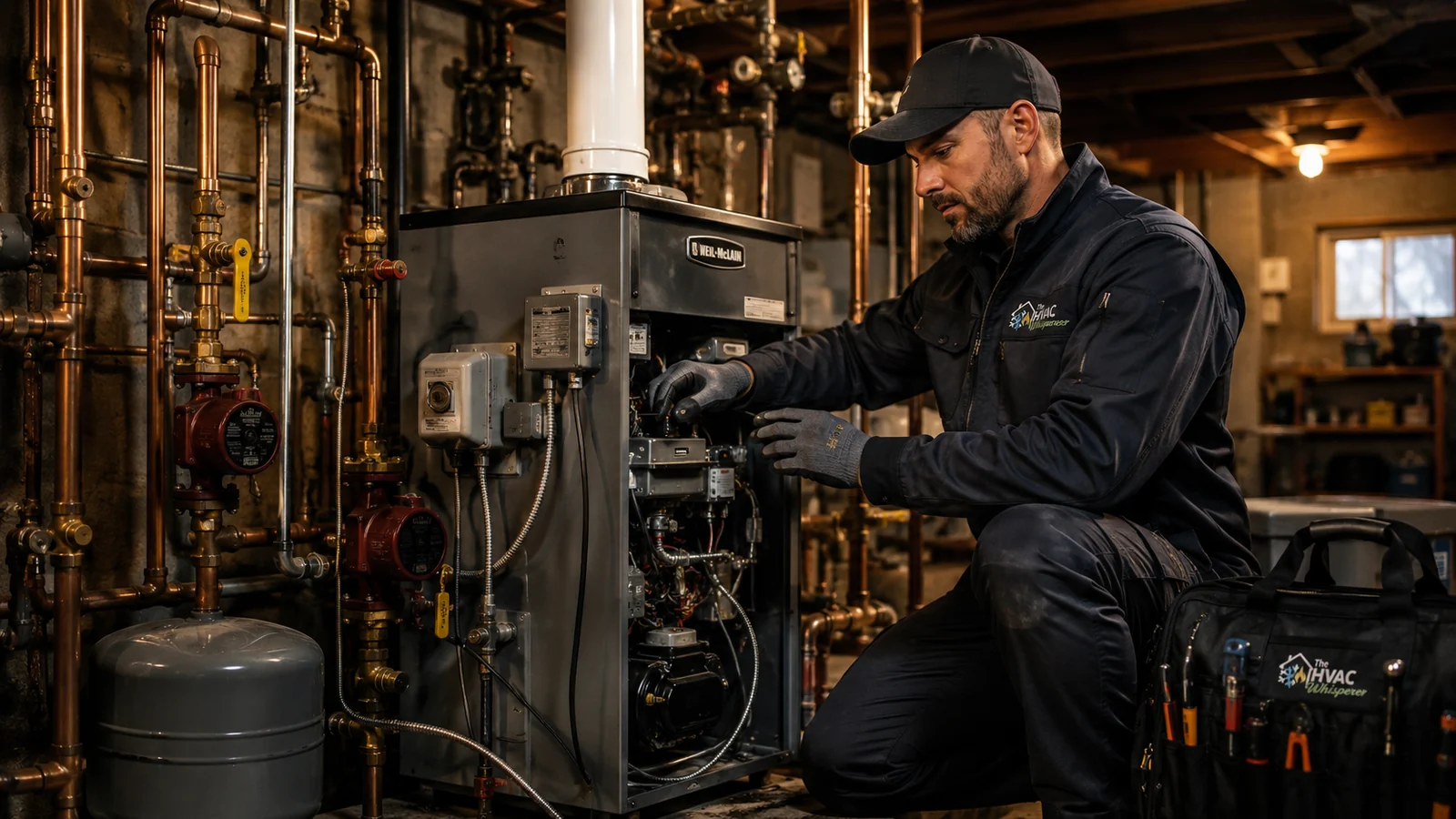
Hydronic heat: boiler, circulators, zone valves, expansion tank, air removal, pressure, controls, piping, and radiators or baseboard can fail in several ways. The symptom is the beginning of the conversation, not the whole answer.
A pressure problem can come from the fill valve, expansion tank, relief valve, air in the system, or a leak that only shows itself under heat.
Noise usually means air, flow, pressure, temperature, or piping issues. The sound is a clue, not the diagnosis.
A cold zone can be a thermostat, circulator, zone valve, air-bound loop, control board, or piping problem.
A drip at the relief valve is different from a leaking circulator, pipe fitting, tankless coil, or boiler section.
Lockouts protect the equipment. Repeated resets can hide ignition, combustion, venting, control, or fuel problems.
That can be flow, air, undersized radiation, dirty fins, poor insulation, or a thermostat location issue.
The goal is to explain the important pieces clearly so the homeowner can ask better questions and choose the next conversation with confidence.
Pressure is read cold and hot because a boiler can look fine at rest and fail under temperature.
A failed or waterlogged tank can push pressure high and make relief valves look like the problem.
Heat has to move. Pumps, valves, transformers, and relays all affect comfort.
Trapped air can stop heat even when the boiler is hot. The piping tells the story.
Gas, propane, and oil boilers need safe draft, clean combustion, and correct burner operation.
Baseboard, radiators, and radiant loops all behave differently in older New York homes.
Use these six questions to decide whether to keep reading, open a guide, or ask for hands-on heating help.
Homeowners dealing with oil, propane & boiler service in herkimer county, ny and wanting a clear answer before spending money.
It explains the most important oil, propane & boiler service in herkimer county, ny facts without turning the page into a technical manual.
Use it when the symptom is active, repeating, seasonal, unsafe, or starting to affect comfort and confidence.
It is written for Fulton, Montgomery, and nearby Upstate New York homes where older houses, rural roads, lake properties, and winter weather change the answer.
The point is to protect comfort, safety, operating cost, and the homeowner's ability to understand the situation clearly.
The path is simple: notice the symptom, understand the likely direction, use the right guide if you want more detail, then request help when the boiler needs hands-on testing.
Local conditions matter for heating. A page that ignores the home, fuel access, winter weather, and property type is not giving the homeowner enough information.
Gloversville, Johnstown, and Amsterdam have plenty of older homes where ductwork, chimneys, basements, and additions can change the heating answer.
Homes near Caroga Lake, Sacandaga, and rural roads need practical thinking around freeze risk, access, fuel delivery, and winter shutdowns.
Cold snaps, wind, snow, and long run times expose weak airflow, burner setup, boiler pressure, and control problems faster than mild weather.
The service page explains the action. The related guides explain supporting details when they help the homeowner understand the situation.
These are the questions that usually come up before someone decides whether to keep reading, request service, or compare replacement options.
It should solve a real comfort, safety, reliability, or operating-cost problem, not simply replace parts because a symptom appeared.
Repair makes sense when the cause is clear, the system is otherwise sound, and the cost does not ignore age, safety, or repeated failure.
Replacement enters the conversation when repairs repeat, comfort is poor, safety is questionable, efficiency is weak, or the system no longer fits the home.
Heating equipment must match the home. Oversized and undersized systems both create comfort and reliability problems.
Yes. Older homes, rural fuel systems, lake properties, additions, and long winters all affect heating choices.
Send the system type, fuel type, age if known, what changed, where you notice it, and whether it is getting worse.
Share the symptom, fuel type, system age if you know it, where you notice the problem, and whether it is active, repeating, or getting worse.
Furnaces, boilers, oil burners, propane systems, ductwork, controls, and venting can all create similar symptoms. The safe path is to look at the cause before replacing parts.
We start with the symptom, thermostat or control call, airflow, fuel source, venting, combustion, water pressure if it is a boiler, and any safety concern before recommending repair, replacement, or maintenance.